
The Fractured Sovereignty: A Comprehensive Register of the Governing Powers of Stellarealm
The Fractured Sovereignty of Stellarealm: A Comprehensive Guide
The political landscape of Stellarealm is a complex and ever-shifting mosaic of influence, a testament to a history marked by both cooperation and conflict. Gone are the ages of singular, undisputed empires; in their stead, a multitude of governing bodies, autonomous entities, and independent peoples vie for influence, their territories and allegiances interwoven in a manner that defies simple cartography. Understanding the nuances of these powers is crucial to navigating the intricate web of alliances, rivalries, and laws that shape life across the Realms.
TABLE OF CONTENTS
Part I: The Eight Pillars of Influence: Primary Governing Bodies
* Chapter 1: The Coastal Concord (The Alliance)
* Chapter 2: The Iron Dominion (The Empire)
* Chapter 3: The Celestial Mandate (The Dynasty)
* Chapter 4: The Silent Conclave (The Council)
* Chapter 5: The Free Companies (The Legion)
* Chapter 6: The Sovereign Collective (The Nation / Republic of The Dawn)
* Chapter 7: The Harmonious Concord (The Union / Concord of Harmonious Boughs)
Part II: Transcendent Authorities & Independent Societies
* Chapter 8: The Impartial Authority: The Order
* Chapter 9: Volatile Remnants: The Lingering Shadow of the Pack
* Chapter 10: Subaquatic Sovereignties: The Merfolk Kingdoms
* Chapter 11: Nocturnal Dominions: The Vampire Courts
* Chapter 12: Subterranean Echoes: Orcish Holds
* Chapter 13: The Unbound Peoples: Tribal Clans & Free Communities
Part III: Geopolitical Analysis & Future Outlook
* Chapter 14: Conclusion: The Precarious Equilibrium of Stellarealm
Chapter 1: The Coastal Concord (The Alliance)
The League of Free Banners, often simply called the Alliance by outsiders or the Coastal Concord by its members, is not a kingdom ruled by a single monarch, nor an empire forged solely by conquest. Instead, it is a dynamic and often boisterous coalition of independent coastal settlements, island communities, and strategically vital trading enclaves. Forged over centuries, its roots tracing back to the Age of Crossroads when coastal communities first sought mutual protection and trade advantages, the Alliance solidified during the tumultuous Rising Era, particularly in the aftermath of the 110 Year War, emerging as a pragmatic counterweight to more centralized powers. From bustling port cities like Free Banner and Port Azure that serve as gateways to the wider world, to secluded island havens such as Isola Lumina rich in unique resources, and from the fertile river deltas that feed burgeoning populations to the hardy communities clinging to the rugged coastlines of the Southern Shore, the Alliance is a tapestry woven from threads of self-governance, maritime strength, and mutual economic interest. While known today primarily as a concord of settlements, the name 'League of Free Banners' perhaps echoes earlier, more martial origins involving independent militias or even mercenary companies coalescing under shared banners, or simply the distinct standards flown proudly by its fiercely independent founding members.
* 1.1 Nature: A Coalition of Independent Coastal Settlements
The Coastal Concord is constituted as a coalition of autonomous coastal settlements, island states, and key trading hubs. Its historical development, initiated in the Age of Crossroads and consolidated during the Rising Era post the 110 Year War, established it as a significant entity balancing against more centralized powers. The fundamental tenets of the Concord include robust self-governance for its member states, a strong emphasis on maritime capabilities, and the pursuit of mutual economic benefit.
* 1.2 Strengths: Economic Leverage, Adaptability, Diplomatic Prowess
The Concord derives its influence from several key strengths:
* Economic Leverage: Control over critical sea lanes within the Azure Sea and portions of the Celestial Sea, coupled with access to extensive maritime resources, endows the Alliance with substantial economic power. It significantly influences inter-regional trade and economic policies.
* Decentralized Innovation and Adaptability: The autonomy of member states promotes innovation in areas such as shipbuilding and craft specialization. This structure allows for rapid adaptation to market changes, piracy threats, and environmental factors, supported by a diverse skill base.
* Diplomatic Prowess: Alliance diplomats are recognized for their adept negotiation skills and pragmatic, commerce-centric foreign policy. They excel at forging beneficial trade agreements and strategic defensive pacts, crucial for maintaining regional stability, particularly in relation to the Empire.
* Abundant Maritime Resources: Extensive fishing grounds, valuable minerals, pearls, and unique island flora contribute significantly to the Concord's prosperity and serve as primary trade commodities.
* 1.3 Weaknesses: Lack of Unified Army, Internal Disagreements, Trade Reliance
The decentralized model of the Concord also presents specific vulnerabilities:
* Lack of a Unified Standing Army: Primary reliance on local militias and distinct naval fleets renders the Alliance potentially vulnerable to concentrated land-based military assaults from centralized states. Coordination of unified ground defense is inherently complex and can be protracted. The engagement of mercenary forces, though occasionally necessary, introduces additional risks.
* Internal Disagreements and Competing Interests: The operational independence of member states can lead to internal policy disagreements and divergent economic or political objectives. Achieving consensus within the central council can be challenging, potentially impeding cohesive action and timely crisis response.
* Susceptibility to Trade Disruptions: The Concord's economic stability is heavily dependent on the secure and uninterrupted flow of maritime commerce. Disruptions stemming from large-scale conflicts, piracy, natural disasters, or hostile actions by rival powers can severely impact its interconnected economy.
* 1.4 Governance: Elected Assemblies, Merchant Guilds, Central Council
The governance structure of the Coastal Concord is characterized by a system of local self-rule complemented by inter-settlement cooperation:
* Local Governance: Authority primarily resides within elected assemblies, influential merchant guilds, and local councils within each member state. These bodies manage local laws, resources, militias, and naval contributions.
* Central Council: To address matters of collective defense, Alliance-wide trade policy, and significant diplomatic initiatives, a central council convenes periodically. This council meets in Oakhaven, an independent city-state in the Silverwood region (Western Lowlands) that maintains strong trade ties with the Alliance and also has ties to the Union of Emerald Boughs. The council comprises representatives from each member state, with decisions typically reached through negotiation and consensus, respecting member autonomy. (The Arcane Council and The Order maintain a presence in Oakhaven but are not formally affiliated with its governance.)
* Grand Assembly: Located in Free Banner, the Alliance capital, the Grand Assembly serves as the highest deliberative body for core members, addressing critical pan-Alliance issues.
* 1.5 Territorial Dominion: Coastal Regions, River Deltas, Resource-Rich Islands
The Coastal Concord's primary sphere of influence spans the western coastal regions of Stellarealm, including fertile river deltas, rugged peninsulas, and numerous islands in the Azure and Celestial Seas. Its influence is palpable along major maritime trade routes. Key territories include:
* The Western Peninsula: Considered the core of Alliance maritime power.
* Free Banner: The capital city, headquarters of the Alliance, seat of the Grand Assembly, and a major command center for the Alliance Navy (Azure Navy).
* Port Azure: A vital, heavily fortified naval base and trading hub on the eastern Peninsula, hosting a significant Azure Navy presence.
* Seadrift: A collection of independent port towns on the northern coast, known for skilled shipwrights and cherishing their autonomy within the Alliance framework.
* The Southern Shore & Uplands: A coastline of cliffs and harbors, backed by agriculturally productive hills.
* Aethelgard, the Azure Port: A key port city on the southern Uplands coast, governed by an elected council and firmly within the Alliance sphere.
* Eldoria, the Vine-Kissed City: An inland city in the Uplands renowned for wine production, with governance blending elected representation and traditional Baronial influence, maintaining strong Alliance ties.
* Olivestone Villages: Independent settlements in the western hills, known for olive oil, maintaining loose affiliations for trade and security.
* The Celestial Sea Littoral: Coastal areas and islands bordering the inland sea. Influence is projected through trade networks and diplomatic connections with entities such as Isola Lumina, the Floating Bazaar of Aquatica, and the Merfolk communities of Coralia.
* The Riverlands of the Great West: Fertile deltas and agricultural valleys. Towns like Riverbend Farms maintain essential economic ties with Alliance coastal markets, despite potential influence from other powers like The Nation.
* The Barony of Grimfang Hold: An independent Human and Werewolf territory in the Spine of the World foothills, maintaining a strategic alliance with the Concord, controlling vital resources and trade passes.
* 1.6 Military Structure: Local Militias, Fortified Ports, Mercenary Fleets (incl. Azure Navy)
The military capabilities of the Coastal Concord reflect its decentralized organization:
* Land Forces: Composed primarily of well-trained local militias maintained by each member state, supported by heavily fortified port cities such as Port Azure and Free Banner.
* Naval Power: Naval supremacy is a fundamental aspect of Alliance strategy. The Alliance Navy, a composite force of warships from member states, is a formidable maritime power. Prominent fleet elements, often referred to as the Azure Navy, are strategically based in Free Banner and Port Azure.
* Auxiliary Forces: The Concord's significant wealth permits the frequent engagement of mercenary fleets to augment its naval strength during major conflicts or campaigns.
* 1.7 Notable Features & Culture: Commerce, Hospitality, Pragmatism
The Coastal Concord is distinguished by several cultural and operational hallmarks:
* Culture of Exchange: Its marketplaces are vibrant centers of inter-regional trade, and its ports serve as melting pots for diverse cultures, languages, and ideas.
* Hospitality and Pragmatism: A strong tradition of hospitality, particularly towards merchants, is prevalent. This is underpinned by a pragmatic approach to commerce and diplomacy, where agreements are predicated on mutual benefit and tangible results.
* Shrewd Diplomacy: Alliance diplomats are noted for their adept negotiation and their ability to navigate complex inter-state relations, frequently forging alliances based on mutual advantage rather than strict ideological congruity.
* Current Foreign Relations: The Alliance maintains a complex, often cautious, relationship with the Empire, characterized by both necessary trade partnerships and underlying strategic rivalry. Its approach to The Nation's ideals varies among its members, influenced by local interests and geographical proximity.
* 1.8 State Heraldry: The Free Shores & Trading Houses
The official symbols of the Coastal Concord are:
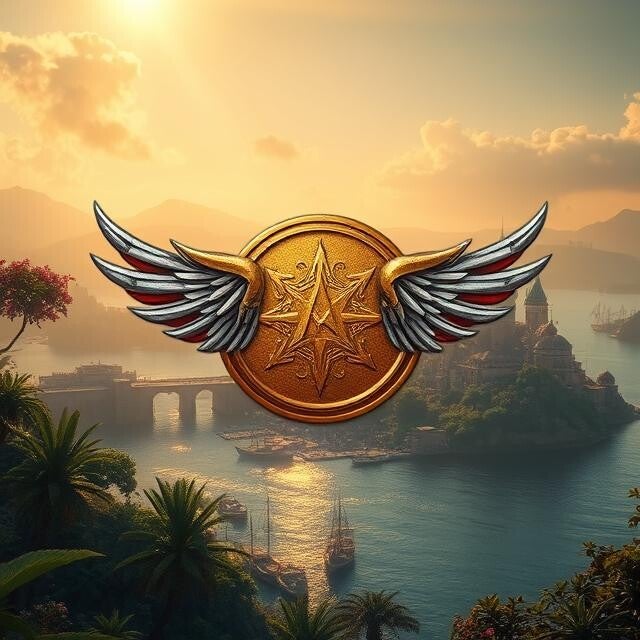
* 1.8.1 Emblem: The Winged Coin
This emblem symbolizes the Concord's dedication to prosperity, the rapid movement of trade across maritime routes, and the principle of freedom of movement that is fundamental to its success.
* 1.8.2 Colors: Gold and Silver
These colors represent the tangible wealth generated through commerce and the diverse range of valuable and practical goods exchanged within its extensive markets.

Chapter 2: The Iron Dominion (The Empire)
The Empire, often referred to with a mixture of respect and fear as the Iron Dominion, represents a sprawling and highly centralized power within Stellarealm. Its foundation is built upon military might and unwavering discipline, established by the human hero Tiberius circa Year 1007 RE, in the aftermath of the 110 Year War and the fall of the Giants. The Empire emerged to impose order upon a fractured world, with its authority vested in a supreme ruler, the Emperor. The current Emperious line traces its lineage directly to Tiberius, maintaining an absolute and largely unquestioned authority within the Empire's core tenets. Its presence is a dominant force, often defined in opposition to the confederated ideals of entities such as the Nation, and it commands both awe for its stability and apprehension regarding its expansionist policies. The designation "Shadow of Titans Throne" signifies the Empire's role in supplanting the ancient dominion of the Giants, assuming stewardship over vast territories.
* 2.1 Nature: Centralized Military Power under a Supreme Sovereign
The Iron Dominion is characterized as a highly centralized state, underpinned by formidable military strength and a strict adherence to discipline. Founded by Tiberius following the conclusion of the 110 Year War (circa 1007 RE), its governance is embodied by a supreme sovereign, the Emperor, whose lineage is traced through the Emperious line. The Empire's political and military posture is often framed in direct opposition to decentralized political entities like the Nation. Its historical claim as the "Shadow of Titans Throne" reflects its ascendancy after the defeat of the Giants.
* 2.2 Strengths: Massive Army, Efficient Resource Mobilization, Vast Territories
The Empire's significant power is derived from several key advantages:
* Massive and Well-Trained Army: The Imperial legions, originating from the forces unified by Tiberius, are distinguished by their considerable size, rigorous training protocols (influenced by principles akin to those of the House of the Ordered Path), and profound loyalty to the Emperor and the Emperious dynastic line. This military apparatus is capable of rapid and decisive action across varied geographical theaters.
* Centralized Authority and Efficient Resource Mobilization: The Empire's centralized governance model facilitates the efficient allocation and mobilization of its extensive resources, including agricultural products, mineral wealth, timber, and manpower, aligning them with Imperial objectives. Directives from the Emperor are executed with celerity and uniformity.
* Vast Territories and Abundant Resources: The Empire controls substantial territories, encompassing fertile plains, mineral-rich mountainous regions (acquired post-Giantfall), strategic waterways, and extensive forests. These holdings provide a diverse resource base crucial for economic self-sufficiency and military sustainment.
* Well-Maintained Infrastructure (Core Territories): Key infrastructure within the Imperial heartlands, such as the Imperial Highways, fortifications, and aqueducts (with design potentially influenced by the House of the Grand Design), is typically maintained to a high standard, supporting essential military logistics, communication, and resource distribution.
* 2.3 Weaknesses: Authoritarian Resentment, Expansionist Conflicts, Rigid Hierarchy
Despite its formidable capabilities, the Iron Dominion is subject to several inherent vulnerabilities:
* Resentment and Rebellion Among Subjugated Populations: The Empire's formation involved the annexation of numerous previously autonomous territories and peoples. Its authoritarian governance, coupled with heavy taxation for resource extraction and the suppression of local customs, frequently engenders significant resentment and sporadic rebellions, necessitating a continuous and resource-intensive military presence, particularly in peripheral regions.
* Frequent Conflicts with Neighboring Powers: The Empire's expansionist foreign policy results in recurrent conflicts and border disputes, notably with ideologically divergent states such as the Nation and economically competitive entities like the Alliance. These engagements strain Imperial resources and contribute to diplomatic instability.
* Rigid Hierarchy Stifles Innovation and Local Initiative: The strict, top-down command structure and emphasis on unequivocal obedience, while ensuring internal order, can inhibit local initiative, adaptation to specific regional exigencies, and broader societal innovation. This rigidity may impede the Empire's ability to adapt effectively to novel threats or evolving circumstances.
* Potential for Dynastic Instability: Systems reliant on absolute hereditary rule, such as the Empire, are inherently susceptible to succession crises, internal court intrigues, and periods of attenuated leadership within the ruling Emperious line, which may be exploited by internal or external adversaries.
* 2.4 Governance: Absolute Sovereign, Bureaucracy of Officials and Commanders
The Iron Dominion is governed by an absolute sovereign, the Emperor, whose pronouncements have the force of law, an authority historically legitimized by Tiberius's foundational victory and the subsequent stability provided by his lineage. The Emperor's will is enacted through an extensive bureaucracy composed of loyal civil officials and high-ranking military commanders. This administrative apparatus operates throughout the Empire, tasked with the implementation of Imperial decrees, efficient tax collection, the administration of justice under Imperial legal codes, and the often-ruthless maintenance of public order. Provincial territories are administered by Governors, appointed directly by the Emperor, who wield significant delegated authority. Their primary responsibilities typically include ensuring resource extraction for the Imperial core and the swift suppression of any dissent or rebellion, often leading to the displacement or dismantling of pre-existing local leadership structures in favor of direct Imperial administration.
* 2.5 Territorial Dominion: Conquered Lands, Fortified Borders
The Iron Dominion's territory comprises extensive regions of central Stellarealm, largely acquired through sustained military conquest during and immediately following the 110 Year War, including the absorption of former kingdoms and lands left vacant after the Giants' demise. Imperial borders, particularly those adjacent to the Nation or other volatile regions, are typically heavily fortified with advanced military engineering. The Imperial heartland remains the most densely populated, economically critical, and thoroughly administered area. Key territories include:
* The Crimson Heartlands (Heartland Plains): An expansive area of rolling grasslands and fertile river valleys surrounding the Great Central River, forming the agricultural and demographic core of the Empire.
* Tiberium, the Imperial Seat: The imposing capital city, strategically located in the Crimson Heartlands, serving as the epicenter of Imperial law, bureaucracy, and military command.
* The Plains of Remembrance: Vast historic plains south of Tiberium, site of decisive battles against King Grom during the 110 Year War and subsequent conflicts during Imperial consolidation; a location for solemn commemoration and military displays.
* Veridia Secunda: A designated model Imperial agricultural zone, critical for provisioning the legions and the capital. Its populace, while loyal, reportedly maintains some external economic relations via river trade, a pragmatic concession by Imperial authorities.
* Sunpetal: A town noted for agricultural innovation, possessing a unique local governance structure (an Elder Council operating under the Imperial Governor). Similar to Veridia Secunda, its inhabitants are known to engage in certain external economic activities.
* The Western Marches: Territories bordering the Nation and potentially the eastern sphere of influence of the Alliance. These regions are frequently subject to border skirmishes and necessitate a significant legionary presence.
* Aethelburg: A strategically vital, heavily fortified city on the Great Central River, recognized for its formidable defenses and its role in supplying legions deployed to the west. Notably, it hosts an Imperial Judicium, indicating the presence and cooperation (or co-option) of judicial functions associated with the Order of the Stalwart Heart within the Imperial legal framework.
* The Iron Forges of Corvus: A sprawling industrial city situated near substantial iron deposits, almost exclusively dedicated to the production of Imperial armaments and armor. Its specialized workforce maintains some necessary external trade links for specific resources, tolerated by the Empire due to its strategic output.
* The Eastern Reach: Territories extending towards the fringes of the Emerald Expanse and the Heartwood, often exploited for timber and other natural resources, which sometimes leads to conflict with independent Vila communities or the reclusive Fae inhabitants of the deeper forests.
* 2.6 Military Structure: Imperial Legions (Land and Sea)
The Imperial legions constitute the primary instrument and embodiment of the Iron Dominion's power. They are characterized by:
* Core Attributes: Harsh discipline, rigorous training regimens, standardized equipment (produced by industrial centers such as Corvus), and unwavering loyalty, instilled through intensive indoctrination and devotion to the Emperor.
* Operational Capabilities: Proficient in rapid marches, complex siege warfare, and decisive engagements in pitched battles.
* Organizational Framework: Structured into highly organized units (e.g., cohorts, legions) led by career officers (e.g., centurions, legates).
* Composition: The ranks are filled by recruits drawn from across the Empire, including humans and members of other races integrated (voluntarily or otherwise) into the Imperial military. Their diverse skills are consolidated into a unified, disciplined force serving the Emperor's objectives, with an increasing operational presence on major waterways.
* 2.7 Notable Features & Ethos: Order, Discipline, Obedience
The Iron Dominion is distinguished by several defining characteristics and a pervasive ethos:
* Ethos of Order and Discipline: A societal emphasis on absolute order, unwavering discipline, and unquestioning obedience permeates all levels, from military structures to civilian administration.
* Military-Focused Infrastructure: Imperial development initiatives prioritize military requirements—such as strategic roadways, fortifications, and supply depots—often over civilian amenities or purely commercial enterprises, particularly in territories outside the core heartlands.
* Legacy of Conquest and Resentment: The Empire's history of expansionism and the subjugation of diverse populations has created an enduring legacy of resentment and resistance within many of its provinces, posing a persistent internal security challenge.
* Imperial Culture: The Empire actively promotes a specific set of values emphasizing loyalty, duty, strength, and reverence for the Emperious line. Imperial architectural styles, artistic motifs, and occasionally linguistic norms are promulgated throughout its territories to foster unity, often overshadowing or suppressing local cultural expressions.
* Relationship with the Houses (of the Celestial Zodiac): While the Emperor's authority is supreme, practical governance often involves interaction with the Houses. The pragmatic principles of the House of the Ordered Path align with Imperial structure, and the House of the Grand Design may influence infrastructure projects. Conversely, Houses that champion individual freedom, untamed nature, or decentralized knowledge may find their activities restricted or closely monitored within Imperial borders.
* 2.8 State Heraldry: The Legion's Shadow
The official symbols of the Iron Dominion are:
* 2.8.1 Emblem: The Stylized Eagle
A stylized eagle with sharp, angular wings serves as the primary emblem. This potent symbol represents dominance, the extensive reach of Imperial authority, vigilance, and the omnipresent oversight of the Emperor across his domain.
* 2.8.2 Colors: Crimson and Scarlet
These hues evoke the bloodshed during the War of Liberation and subsequent conquests, symbolizing the sacrifices demanded for Imperial unity and the intrinsic color of Imperial power itself. They serve as a constant reminder of the Empire’s origins and its methods of maintaining authority.

Chapter 3: The Celestial Mandate (The Dynasty)
The Celestial Mandate, often referred to by external entities as the Dynasty, constitutes an ancient and profoundly tradition-bound sovereign realm located in the eastern territories of Stellarealm. Distinct from the mercantile leagues of the west or the expansionist ambitions of other major powers, the Dynasty's enduring strength is predicated on its deep-rooted cultural homogeneity, the abiding spiritual authority of its hereditary monarchs, and its extensive, stable history. Its origins trace back to the nascent periods of recorded history, with a deliberate preservation of ancient celestial reverence, even as other regions underwent significant ideological shifts during historical epochs such as the Age of Sundered Heavens. From its majestic temples that dominate the capital's skyline to the serene ancestral shrines prevalent throughout its lands, the Celestial Mandate is a domain where tradition exerts paramount influence, and the celestial order is devoutly believed to direct the destiny of its populace.
* 3.1 Nature: Ancient Realm with Divinely Ordained Hereditary Rule
The Celestial Mandate is characterized as an ancient realm governed by a hereditary ruling line whose authority is perceived as divinely ordained. Situated in eastern Stellarealm, its societal structure and governance are deeply influenced by tradition and a strong belief in celestial guidance. This entity has consciously maintained ancient forms of celestial reverence throughout its long history, distinguishing its developmental trajectory from that of other major powers.
* 3.2 Strengths: Cultural Unity, Spiritual Authority, Historical Stability
The sustained power and stability of the Celestial Mandate are derived from several core attributes:
* Deep-Rooted Cultural Unity and Strong Sense of Tradition: Millennia of shared history, language, philosophical precepts, and adherence to ancient customs have fostered a profound cultural unity, contributing to remarkable social cohesion and internal stability.
* Widespread Spiritual Authority: The prevalent belief in the divine mandate bestowed upon the Celestial Emperors commands significant respect among the populace, serving as a potent unifying force and reinforcing the legitimacy of the ruling dynasty.
* Long History Providing Stability and Continuity: The Dynasty’s exceptionally long and relatively unbroken historical narrative affords unparalleled stability and continuity, anchoring its society in tradition and providing a sense of permanence uncommon in Stellarealm.
* Renowned Artistry and Craftsmanship: Dynastic artisans are acclaimed throughout the Realms for their exquisite artistry, intricate techniques, and the profound spiritual significance imbued in their creations, which include luminous silk tapestries depicting celestial events and enchanted porcelain vessels utilized in sacred rites.
* 3.3 Weaknesses: Resistance to Change, Internal Power Struggles
Despite its enduring strengths, the Celestial Mandate also exhibits certain inherent limitations and vulnerabilities:
* Resistance to Change and Slow Adaptation: A profound reverence for tradition and rigidly defined social hierarchies can render the Dynasty resistant to necessary reforms and slow its adaptation to rapidly evolving external conditions or novel threats.
* Potential for Internal Power Struggles: While generally stable, the Dynasty may experience occasional internal power struggles among influential noble families vying for Imperial favor, or within the powerful priestly class responsible for interpreting celestial will. Such struggles can potentially destabilize the ruling lineage or impede effective governance.
* Slow Decision-Making Processes: A strong emphasis on ritual propriety, adherence to historical precedent, and the extensive consultation required by tradition can result in slow and deliberate decision-making processes. This may hinder swift responses to sudden external threats or acute internal crises.
* Vulnerability on Western Borders: Despite a general policy of isolationism, historical conflicts (such as those during the Age of Broken Thrones and Age of Strife) have occasionally compelled the Dynasty to defend its western borders and critical trade routes, thereby revealing potential vulnerabilities to sustained external military pressure.
* 3.4 Governance: Hereditary Sovereign, Priestly Class (Twelve Houses), Noble Families
The Celestial Mandate is governed by a hereditary sovereign, the Celestial Emperor, who is venerated not merely as a political leader but as a living conduit to celestial powers, embodying the connection between the heavens and the terrestrial realm. Consequently, Imperial pronouncements carry significant spiritual weight in addition to temporal authority.
* Priestly Class: A powerful priestly class, tasked with interpreting the celestial order and guiding sacred rituals, wields considerable influence. This class advises the Emperor and upholds ancient traditions, and is closely associated with the regional manifestations and interpretations of the Twelve Houses as they exist within the Dynasty's borders.
* Noble Families: Influential noble families, bound by intricate codes of tradition, lineage, and loyalty, constitute a critical component of the ruling elite. Their disciplined warrior retinues significantly contribute to the Dynasty's military strength.
* 3.5 Territorial Dominion: Historic Lands, Sacred Sites, Cultural Sphere of Influence
The territory of the Celestial Mandate encompasses the eastern heartlands of Stellarealm, lands steeped in millennia of history and imbued with profound spiritual significance. The landscape is characterized by magnificent temples dedicated to celestial patrons, serene ancestral shrines honoring countless generations, and ancient burial grounds that serve as tangible links to the Dynasty’s long and revered lineage. Key territories include:
* The Eastern Heartland (The Golden Cradle): The fertile core of the Dynasty, rich in history, agricultural output, and sacred sites. While primarily focused internally, Dynastic influence and resource requirements occasionally extend westward into the fringes of the neighboring Emerald Expanse.
* Xylos, the Golden City: The magnificent capital, situated at the foot of the Celestial Mountains, is a sprawling metropolis of exceptional artistry and paramount spiritual importance. It serves as the seat of the Celestial Emperor, home to the Grand Celestial Spire, and the undisputed center of Dynastic cultural, political, and religious authority.
* Riverton: Located along the Great Eastern River, this hub facilitates internal trade and transport. Predominantly inhabited by humans skilled in commerce, it possesses significant local autonomy through its Merchant Guild, under overarching Dynastic governance. It notably hosts an Order of the Stalwart Heart Judicium.
* The Artisan Guildholds of Porthaven: A region of rolling hills known for rich clay deposits, comprising interconnected guildholds specializing in crafts such as Ogre pottery, Human weaving, and Golem metalwork. These guilds operate with considerable self-governance in return for providing high-quality goods and tribute.
* The Sunstone Orchards: Situated in the fertile southern reaches of the Eastern Heartland, this region features vast orchards cultivating unique, magically enhanced fruits. These orchards are primarily tended by autonomous Vila farming communities operating under ancient agreements with the Dynasty.
* The Celestial Mountains: A mystical and revered mountain range, considered part of the greater Spine of the World, bordering the Eastern Heartland to the north and east.
* The Silent Monasteries of the Sky Peaks: Located on isolated, mist-shrouded peaks, these ancient monasteries are inhabited by monks (predominantly Human and Kitsune) dedicated to contemplation, martial arts, celestial observation, and lore preservation. While acknowledging the spiritual authority of the Dynasty, they maintain complete internal autonomy.
* 3.6 Military Structure: Temple Guards, Retinues of Noble Warriors
The military strength of the Celestial Mandate is founded less on sheer numbers or expansionist doctrine and more on discipline, faith, and tradition.
* Temple Guards: Comprise dedicated personnel, often imbued with deep religious fervor, highly skilled in unique martial arts intertwined with spiritual practices, potentially drawing upon forms of Celestial Magic aligned with Dynastic beliefs.
* Noble Warrior Retinues: Consist of hereditary forces bound by codes of honor and loyalty to both their sovereign and their ancestral houses.
* Defensive Posture: While primarily focused on internal stability and spiritual matters, historical conflicts along its western borders have necessitated the maintenance of capable defensive forces.
* Warrior Monasteries: Located within the Celestial Mountains, these serve as elite training centers for martial monks and act as formidable defensive strongholds guarding the Dynasty's northern and eastern approaches.
The core strength of the Dynastic military lies in its unwavering discipline, profound faith in the Emperor’s mandate, and adherence to time-honored martial traditions.
* 3.7 Notable Features & Culture: Ritual, Tradition, Ancestor Veneration, Artistry
The Celestial Mandate is distinctly characterized by several enduring features:
* Emphasis on Ritual and Tradition: Daily life, from the common populace to the Emperor, is deeply interwoven with elaborate rituals, ancient customs, seasonal ceremonies, and the veneration of ancestors and celestial patrons. This framework provides a profound sense of order, continuity, and shared identity.
* Renowned Artistry and Spiritual Significance: Dynastic artistry and craftsmanship are acclaimed across Stellarealm not only for their exquisite beauty and technical skill but also for the profound spiritual meaning and cosmological symbolism integrated into nearly every creation.
* Profound Cultural Influence: Over millennia, the Dynasty’s sophisticated culture, intricate philosophies, unique aesthetics, and deeply held beliefs have subtly shaped artistic expression, philosophical thought, governance models, and spiritual practices far beyond its designated borders, leaving an enduring imprint on the cultural tapestry of Stellarealm.
* 3.8 State Heraldry: The Divine Mandate
The official symbols of the Celestial Mandate are:
* 3.8.1 Emblem: The Stylized Celestial Body (Sun and Moon)
A stylized celestial body, often depicting the Sun and Moon intertwined or in harmonious alignment, serves as the primary emblem. This symbol represents the Dynasty’s claimed divine lineage and the harmonious balance of cosmic forces purported to be maintained under their rule.
* 3.8.2 Colors: Gold, Saffron Yellow, and Ivory
These hues are traditionally associated with spiritual enlightenment, the perceived brilliance of the heavens, the authority of the Emperor, and the purity of ancient traditions.

Chapter 4: The Silent Conclave (The Council)
The Silent Conclave, more commonly referred to simply as the Council or by its formal designation, the Arcanum Concord, represents a unique institutional entity within Stellarealm. It is not constituted as a conventional kingdom defined by terrestrial borders, but rather operates as a dispersed network of secluded academies, ancient libraries, concealed archives, and sites imbued with potent magical energies, distributed across the continent. The Conclave embodies a confluence of authority and esoteric knowledge, comprising an assembly of elder mages, the leadership of ancient scholarly orders (some with lineages extending over centuries), and the revered masters of mystical guilds. These diverse elements are ostensibly unified by a profound dedication to the study, preservation, and responsible advancement of arcane knowledge in all its manifestations. From imposing spires located on remote mountain peaks to hidden groves resonant with forgotten enchantments within ancient forests, the Council’s influence emanates subtly yet powerfully from these centers of learning, shaping the comprehension and practice of magic throughout the Realms. Its origins are traceable over several centuries, having evolved gradually from rudimentary colleges of magic established during the Rising Era into the esteemed, albeit reclusive, institution it is recognized as in the current New Era, navigating the complex geopolitical environment as a distinct and often enigmatic major power.
* 4.1 Nature: Assembly of Mages, Scholarly Orders, and Mystical Guilds
The Silent Conclave is constituted as a decentralized assembly, comprising esteemed elder mages, the leadership of ancient scholarly orders, and the masters of significant mystical guilds. This collective is primarily characterized by its dedication to the comprehensive study, meticulous preservation, and ethical advancement of arcane knowledge. Originating from early magical colleges of the Rising Era, it has evolved into a recognized, albeit often enigmatic, major power within Stellarealm. Its operational centers include secluded academies, ancient libraries, and sites of potent magical energy.
* 4.2 Strengths: Arcane Mastery, Vast Lore, Respected Counsel
The influence and capabilities of the Silent Conclave are principally derived from its exceptional command over arcane arts and the extensive repository of knowledge it safeguards:
* Unparalleled Mastery of the Arcane Arts: Mages affiliated with the Council typically possess a depth of understanding and a mastery over diverse forms of magical energy that is generally considered unmatched. They are capable of wielding spells of immense potency and studying the manipulation of fundamental cosmic forces often beyond the grasp of most other practitioners.
* Vast Libraries of Forgotten Lore: The Conclave's ancient libraries and hidden archives contain an extensive collection of forgotten knowledge, including scrolls in defunct languages, star-charts from vanished civilizations, grimoires detailing pre-modern magical practices, and unique historical accounts. These archives hold information concerning significant historical events such as the Age of Falling Stars and the enigma of the Star Children.
* Invaluable Wisdom and Long-Term Perspective: Elder mages within the Council, having dedicated extensive periods, sometimes centuries, to arcane study and historical observation (including events like the 110 Year War), possess a unique long-term perspective. Their counsel is often sought by other powers facing complex magical threats or requiring arcane insights.
* Significant Weight on Magical Matters: The Council’s pronouncements on magical theory, the classification and regulation of potentially hazardous spells or artifacts, the identification of magical phenomena, and the ethics of arcane practice carry considerable authority throughout Stellarealm. Its decrees are generally heeded due to its recognized expertise and the potential repercussions of disregarding its guidance.
* 4.3 Weaknesses: Slow Deliberation, Perceived Detachment, Internal Disagreements
The reclusive, contemplative, and internally complex nature of the Silent Conclave presents certain operational limitations:
* Slow and Deliberate Decision-Making: Reflecting a meticulous and cautious scholarly approach, the Council’s collective decision-making processes are often protracted and governed by extensive protocol. This can result in delays when responding to immediate, rapidly developing threats or mundane concerns.
* Perceived Detachment from the Mundane World: The Council’s intense focus on arcane scholarship, cosmic balance, and its members' often physically secluded lifestyles can lead to a perceived disengagement from the immediate political and practical realities confronting other governing bodies and populations. This may limit its direct influence on daily socio-political affairs, although its indirect influence remains substantial.
* Internal Disagreements and Power Struggles: Despite a shared dedication to arcane knowledge, the Council is composed of powerful individuals, ancient orders with distinct histories, and guilds with specific interests. Consequently, internal disagreements regarding magical philosophy, research priorities, ethical boundaries, or resource allocation, along with occasional power struggles among influential archmages or factions, can sometimes impede its capacity for unified action.
* 4.4 Governance: Council of Mages and Guild Masters
The Silent Conclave is governed by a council, the precise composition and operational mechanisms of which are closely guarded secrets. This governing body comprises the most powerful and knowledgeable mages, the heads of the most ancient and influential scholarly orders (some potentially tracing philosophical origins to Houses dedicated to knowledge or cosmic understanding), and the revered masters of significant mystical guilds.
* Primary Focus of Deliberations: Council deliberations are principally focused on the advancement of arcane research across all disciplines, the meticulous preservation and study of potent magical artifacts, the containment of dangerous arcane phenomena, and the rigorous, highly selective training of new generations of mages within its institutions.
* Decision-Making Process: Decisions are typically reached through extensive debate, careful consideration of both immediate and long-term magical consequences, and a pursuit of consensus among its diverse and often strong-willed membership. The potential ramifications of any major action on the delicate balance of arcane energies within Stellarealm are assessed with utmost gravity.
* Formal Gatherings: Formal meetings are convened within heavily warded chambers, often situated in magically significant locations or neutral territories, such as the independent city-state of Oakhaven (located in Silverwood, Western Lowlands), where the Council maintains a notable presence but holds no formal political affiliation. These convocations are invariably characterized by ritual and palpable arcane energy, reflecting the profound nature and potential impact of their proceedings.
* 4.5 Territorial Dominion: Secluded Academies, Ancient Libraries, Magical Sites
The Silent Conclave's dominion is not defined by conventional political borders but rather by the physical locations of its secluded academies, ancient libraries, research facilities, and sites imbued with potent, often unique, magical energies. These centers of arcane study frequently lie outside the direct political control of other governing bodies or exist within them by ancient treaty, generally respected as neutral grounds dedicated to the pursuit of knowledge. Notable locations under Council influence or hosting a significant Council presence include:
* The Grand Athenaeum of Eldoria: Situated within the Alliance-controlled Barony of Eldoria (Southern Uplands), this ancient library is a prominent public-facing repository of arcane knowledge.
* The Scholarium Arcanum of Silverwood: Located within the Heartwood (near the city-state of Silverwood, Western Lowlands), this prestigious academy specializes in natural magic, elemental forces, and communion with nature spirits, with occasional contributions from Vila and Djinn masters.
* The Obsidian Citadel of Nightfall Peaks: Positioned high in the Spine of the World mountains, this formidable structure is a primary center for the advanced study of Vail Magic, encompassing life, death, undeath, and the afterlife, with contributions from various scholars, including Draugar and Wraiths.
* Sunbreak Spire: An isolated tower on the eastern border of the Southern Uplands, serving as a renowned astronomical and astrological observatory under Council purview.
* The Aetherium Academy and College: A large magical academy complex on the border between the Southern Uplands and the Southern Waste, dedicated to diverse arcane learning and research.
* The Obsidian Monoliths: Enigmatic black pillars located in the Southern Waste (and potentially other remote areas such as the Spine), which are sites of intense scholarly investigation.
* The Isle of Whispers: A mist-shrouded island off the Western Peninsula, home to a reclusive order of Vila seers whose precognitive practices are of interest to Council scholars.
* 4.6 Military Structure: Powerful Mages, Magically Animated Guardians
The Silent Conclave does not maintain large standing armies in the conventional military sense. Its defensive capabilities and means of projecting power are primarily based on:
* Arcane Might of Mages: The formidable arcane abilities of its individual ranking mages, who are capable of wielding devastating spells (drawing predominantly, but not exclusively, from Weave magic) and commanding potent arcane energies.
* Magical Defenses and Guardians: Its academies, libraries, and sensitive research sites are typically protected by powerful magical wards and legions of magically animated guardians, such as enchanted constructs of stone, rune-bound metal, or coalesced energy, which are tireless and loyal to their creators or controllers.
* Collective Arcane Power: In times of significant peril, particularly when the balance of arcane energies or substantial repositories of knowledge are threatened, the elder mages of the Council can collectively unleash arcane forces capable of decisively influencing battles or neutralizing threats beyond the capacity of conventional military forces.
* 4.7 Notable Features & Role: Repository of Arcane Knowledge, Unravelers of Mysteries
The Silent Conclave is distinguished by several key characteristics that define its role within Stellarealm:
* The Primary Repository of Arcane Knowledge: The Council functions as the principal guardian, collector, and repository of both theoretical and practical arcane knowledge in Stellarealm, preserving lore that might otherwise be lost to time, conflict, or neglect.
* Dedicated Scholars of the Cosmos: Council scholars, across numerous disciplines and affiliated orders, are committed to unraveling the fundamental mysteries of magic in its diverse forms, the structure of the cosmos, the nature of reality, and the history of the world. Their discoveries and insights often indirectly influence events.
* Neutral Arbiters of Arcane Law: In disputes specifically concerning magical artifacts, the misuse of dangerous spells, breaches of long-standing arcane tradition, or conflicts between powerful magic-users, the Council often serves as a neutral arbiter. Its wisdom and authority in such matters are generally respected, rendering its judgments highly influential, if not always strictly enforceable by its own means.
* 4.8 Organizational Heraldry: The Keepers of the Arcane
The official symbols of the Silent Conclave are:
* 4.8.1 Emblems: The Quill and an Open Tome
These emblems represent the Council’s unwavering commitment to the preservation of existing knowledge and the relentless pursuit of new understanding, encompassing both written and experiential forms of wisdom.
* 4.8.2 Colors: Deep Indigo and Violet
These hues are traditionally associated across many cultures with mystery, profound wisdom, psychic perception, and the intrinsic essence of the arcane arts.

Chapter 5: The Free Companies (The Legion)
The Legion, known interchangeably throughout the Realms as the Free Companies or, more formally, by the appellation Steel Contract, constitutes a vast and renowned mercenary army. Its ranks are composed of battle-hardened veterans drawn from countless conflicts across Stellarealm, offering their formidable martial skills and unwavering loyalty—contingent upon remuneration—to the highest bidder. Distinct from established powers such as the Empire or the Nation, which possess fixed territories, hereditary leadership, and national allegiances, the Legion operates as a nomadic entity across the various regions. Originating from disparate sellsword bands during the chaotic Dark Era, the Legion was forged into a more cohesive and disciplined organization throughout the conflicts of the Rising Era, notably solidifying its presence during the Age of Rising Tensions. It has since become a permanent and influential fixture in the military landscape of Stellarealm. The Legion's presence is a constant variable in the delicate balance of power, its allegiance tied solely to contractual agreements, the promise of monetary reward, and, for some of its members, the inherent allure of combat.
* 5.1 Nature: Mercenary Army Unbound by Territorial Loyalties
The Free Companies function as a large-scale mercenary army, distinguished by its lack of fixed territorial allegiances or sovereign fealty. Its personnel are predominantly combat-experienced veterans who provide military services under contractual agreement. The organization evolved from disparate mercenary groups of the Dark Era, achieving greater cohesion during the Rising Era and establishing itself as a significant military entity by the Age of Rising Tensions. Its operational philosophy is fundamentally transactional, with allegiance directed by contract and payment rather than national or ideological imperatives.
* 5.2 Strengths: Highly Skilled Veterans, Adaptability, Strategic Flexibility
The considerable power and influence of the Free Companies are derived from several key attributes:
* Highly Skilled and Battle-Hardened Veterans: The ranks of the Legion are primarily composed of soldiers with extensive combat experience gained in numerous conflicts across diverse geographical terrains (e.g., Spine of the World foothills, Emerald Expanse) and against varied adversaries (e.g., Giants, rival kingdoms, monstrous creatures, internal dissidents). This experiential depth renders them a formidable and adaptable military force, capable of executing complex tactical maneuvers with high efficiency.
* Strategic Flexibility and Swift Deployment: Being unbound by the defense of specific homelands or territorial obligations, the Legion operates with exceptional strategic flexibility. It can concentrate and deploy its forces rapidly to any location where its services are contractually required, making it a valuable, albeit costly, asset for factions requiring rapid military reinforcement or intervention.
* Internal Discipline and Efficiency: The Legion’s internal command structure, refined over centuries of warfare, promotes a high degree of discipline and operational efficiency, particularly when compared to feudal levies or hastily conscripted militias. While motivated by profit, the Legion's adherence to a strict code of conduct concerning operational duties and contract fulfillment (though off-duty conduct may vary) ensures cohesion and order during campaigns. This structured approach bears some resemblance to principles valued by institutions such as the House of the Ordered Path.
* 5.3 Weaknesses: Reliance on Contracts, Questionable Long-Term Reliability, Internal Power Struggles
Despite its formidable military capabilities, the Free Companies are subject to inherent limitations and vulnerabilities:
* Reliance on Contracts for Sustenance: Lacking a permanent territorial base for taxation or fixed sources of revenue beyond plunder (which is often contract-dependent), the Legion is entirely reliant on securing military contracts for its financial and logistical sustenance, including personnel payment, supplies, and equipment maintenance. This dependence can render the organization vulnerable during extended periods of widespread peace or when lucrative contracts become scarce.
* Loyalty Tied to Financial Compensation: The Legion’s allegiance is fundamentally transactional, primarily bound by the terms of engagement specified in a contract and the timely provision of financial remuneration. This raises persistent questions regarding its long-term reliability as an ally, as a significantly more lucrative offer from a rival faction or the perceived inability of an employer to meet financial obligations could potentially lead to a shift in allegiance. This mercenary characteristic has historically engendered wariness among established powers, even when utilizing Legion services.
* Potential for Internal Power Struggles: While generally maintaining cohesion during active campaigns, the Legion is composed of ambitious individuals and distinct company commanders. Competition for greater authority, influence, and a larger share of spoils among ranking officers (e.g., Centurions, Tribunes) can occasionally lead to internal power struggles. Such conflicts, though often resolved internally, can temporarily destabilize the organization and disrupt its operational effectiveness.
* 5.4 Governance: Council of Senior Officers, Supreme Commander
The governance of the Free Companies is primarily vested in a council composed of its most senior and respected officers. Authority within this council is not inherited but earned through demonstrated battlefield success, strategic acumen, logistical capability, and the respect of the troops under command.
* Council of Officers: This council typically consists of seasoned Centurions (commanding company-sized units) and Tribunes (often overseeing larger formations or specialized branches such as cavalry or siege engineers). It makes collective decisions regarding major contracts, large-scale deployments, resource allocation, and internal disciplinary matters.
* Supreme Commander (Iron Hegemon): A supreme commander, often the most charismatic, strategically gifted, and militarily successful among the senior officers, typically leads the entire organization. This leader, known by the title of Iron Hegemon, holds immense practical power. However, their authority is contingent upon their continued ability to achieve victories, secure profitable contracts, maintain discipline, and ensure the consistent flow of payment necessary to sustain the companies. Failure in these regards can lead to swift replacement through council vote or, in some instances, violent challenge.
* 5.5 Territorial Operations: Realm-Wide Temporary Encampments
The operational domain of the Free Companies is not defined by fixed geographical borders or permanent settlements. Instead, the Legion functions as a mobile entity across the Realms, establishing temporary, heavily fortified encampments and strongholds as dictated by its current contractual obligations and logistical requirements. These encampments, often constructed with notable speed and efficiency by dedicated engineer corps, serve as mobile bases of operation, logistical hubs, and recruitment centers, enabling rapid deployment to any theater of war. The Legion's presence in proximity to a region often signifies imminent conflict or, conversely, a period of temporary, enforced peace secured by a local power. Its influence is felt wherever military conflicts arise.
Frequent encounters and interactions are possible in numerous locations, including:
* Port Azure (Alliance Territory): A major port where Legion commanders might negotiate naval transport contracts, secure passage, or recruit personnel.
* Oakhaven (Neutral/Union City-State): A diplomatic hub potentially used for high-stakes contract negotiations.
* Eldoria (Alliance Territory): Legion detachments may be contracted for protection of trade routes or defense against local threats.
* 5.6 Military Structure: Diverse Soldiers, Strict Code of Conduct
The core strength of the Free Companies lies in the diverse composition of its soldiery. Its ranks comprise individuals from numerous backgrounds and races across Stellarealm, united by shared combat experience, adherence to the Companies’ strict operational code, and the pursuit of martial excellence and remuneration. Their combat effectiveness stems from formidable individual skills, tactical flexibility derived from diverse unit compositions, and unwavering discipline under fire. Notable examples within the Legion's ranks include:
* Human Legionaries: Typically forming the disciplined core of heavy infantry, these hardened veterans hail from various human kingdoms and cultures, proficient with a range of standard weaponry.
* Ogre Berserkers: Recruited from Ogre clans, their immense strength and ferocity make them effective shock troops.
* Vila Scouts: Possessing natural aerial capabilities, Vila mercenaries provide valuable reconnaissance and scouting services.
* Werewolf Auxiliaries: Recruited from remnants of the fallen Pack (post-Age of the Fangs), these werekin offer ferocity, tracking skills, and resilience, often employed as trackers, skirmishers, or specialized assault troops.
* 5.7 Notable Features & Reputation: Effective Combat Force for Hire
The Free Companies are characterized by several key features that define their role and reputation within Stellarealm:
* A Significant Military Force: The Legion represents one of the most substantial independent military forces in Stellarealm, capable of fielding large, well-equipped, and highly experienced armies. Its services are consistently sought by a variety of polities and organizations. Its effectiveness and willingness to engage for most causes (contingent upon payment) make it a powerful, albeit often morally ambiguous, actor in the political landscape.
* Pragmatic Approach to Warfare: The Legion’s conduct of warfare is almost purely pragmatic, dictated by contractual terms and the objective of achieving victory efficiently to secure payment and maintain its reputation. Operations are generally driven by profit and professional pride, not by ideology or national loyalty, distinguishing it from the state armies of powers like the Empire or the Nation. This pragmatism makes the Legion both a valuable military asset and a potentially unpredictable entity if its objectives diverge from an employer's long-term interests.
* Unwavering Commitment to Contracts (If Paid): Once a contract is formally ratified and initial payment or agreed-upon security is provided, the Legion is renowned for its commitment to fulfilling its terms, often fighting with ferocious determination until the objective is achieved or the contract period concludes. This professional reliability is fundamentally contingent upon the sustained flow of remuneration and the perception that employers are capable and willing to uphold their contractual obligations. Defaulting on payment to the Steel Contract is widely considered inadvisable.
* 5.8 Organizational Heraldry: The Steel Contract
The official symbols of the Free Companies are:
* 5.8.1 Emblems: The Crossed Sword and Axe
These emblems are potent symbols representing the Legion’s martial prowess across different forms of combat, its readiness for any conflict, and the fundamental tools of its profession.
* 5.8.2 Colors: Steel Grey and Blood Orange
These colors evoke the stark reality of their weaponry and armor, contrasted with the heat and bloodshed of battle, serving as a visceral reminder of their profession and the often violent means by which victory is achieved.

Chapter 6: The Sovereign Collective (The Nation / Republic of The Dawn)
The Republic of The Dawn, often referred to more formally as the Sovereign Collective, or simply "the Nation" by more established powers, constitutes a unique political entity within the New Era (commencing Year 1501). It is characterized less as a contiguous, monolithic state and more as a nascent power manifested in scattered, albeit interconnected, communities and regions unified by shared revolutionary ideals. Its origins are directly traceable to the aftermath of the devastating 110 Year War (concluding circa 1007 RE). Arising from the widespread destruction of that conflict, its very existence embodies the revolutionary spirit that permeated parts of western Stellarealm, fueled by a collective desire to prevent any single power—be it Giant or otherwise—from achieving future dominance. The Republic's foundational principles explicitly reject ancient monarchical traditions, pragmatic yet often self-serving alliances, and the centralized authoritarianism exemplified by its contemporary rival, the Empire, which emerged concurrently from the same conflict but espoused opposing ideologies.
The Republic is instead founded upon progressive tenets of self-governance, popular sovereignty, and the inherent rights of all its citizens. Its philosophical underpinnings can be traced to diverse communities—ranging from the fiercely independent clans of the Northern Expanse and Coastal Fringe settlements to the liberated populations of the Western Lowlands—that resisted both Giant tyranny and, subsequently, the encroaching authority of the consolidating Empire.
* 6.1 Nature: Nascent Power Based on Liberty, Equality, and Popular Sovereignty
The Sovereign Collective is a nascent political power, comprising geographically dispersed but ideologically united communities and regions. Its core principles are liberty, equality, and popular sovereignty. Formed in the aftermath of the 110 Year War (ending c. 1007 RE), it fundamentally rejects monarchical traditions and centralized authoritarianism, positioning itself as a revolutionary force. Its philosophical origins lie in various groups that resisted past tyrannies and emerging imperial authority.
* 6.2 Strengths: Popular Support, Commitment to Ideals, Revolutionary Spirit
The Republic of The Dawn, despite its relative youth, derives considerable strength from several defining characteristics:
* Strong Popular Support and Fervent Commitment to Progressive Ideals: The Republic typically enjoys substantial support from its citizenry, who are often deeply committed to its revolutionary ideals of liberty, equality, and popular sovereignty. This dedication serves as a potent source of internal cohesion and resilience against external pressures.
* Emphasis on Social Justice and Equality: A foundational principle of the Republic is its commitment to social justice and the pursuit of greater equality compared to older, more hierarchical regimes. This focus attracts individuals and groups marginalized or oppressed elsewhere, fostering a diverse and impassioned populace dedicated to defending its progressive values.
* Revolutionary Spirit Fostering Innovation: Having emerged from revolution against the old order of the Giants and in ideological opposition to newer imperial structures, the Republic cultivates a spirit of innovation and a willingness to challenge established norms. This proclivity extends beyond governance and social structures to often include new approaches in technology, commerce, and the arts, unencumbered by centuries of rigid tradition.
* 6.3 Weaknesses: Lack of Established Institutions, Geographic Dispersion, Internal Divisions, External Hostility
As a nascent and geographically fragmented power existing within a world of long-established entities, the Republic of The Dawn confronts several inherent challenges:
* Lack of Deep-Rooted Traditions and Established Institutions: In contrast to powers like the Dynasty or the Empire, which benefit from centuries of established customs, legal frameworks, and bureaucratic institutions, the Republic is still in the process of actively forging its own traditions and solidifying its governing structures. This developmental stage can sometimes lead to procedural inefficiencies or render it potentially vulnerable to internal instability during crises.
* Internal Political Divisions and Ideological Debates: The very freedoms of expression and democratic principles valued by the Republic can occasionally lead to passionate, and sometimes fractious, internal political divisions and ideological debates within its governing assemblies. Consequently, achieving consensus and implementing cohesive, decisive action can be slower or more challenging compared to autocratic regimes.
* Target of Suspicion and Hostility from Conservative Regimes: The Republic’s revolutionary character and its explicit challenge to traditional monarchical or hierarchical power structures frequently make it a target of suspicion, diplomatic hostility, and occasionally covert actions from more conservative regimes in Stellarealm, which perceive its ideals as a potential threat to their own stability.
* Geographical Dispersion: The scattered nature of its territories, often separated by lands controlled by other powers or vast wildernesses, presents significant logistical challenges for unified defense, swift administration, and the maintenance of infrastructure.
* External Relations: Continuous friction with the neighboring Empire over territorial claims and ideological differences, alongside complex and often shifting rivalries with the Alliance concerning coastal influence and trade, consumes substantial resources and diplomatic efforts.
* 6.4 Governance: Elected Assemblies, Representative Councils
Consistent with its founding principles, the Republic of The Dawn is governed by elected assemblies and representative councils at various tiers, designed to reflect the collective will of its diverse citizenry.
* The Grand Assembly: Convened in the city of Veridia, the Grand Assembly serves as the highest coordinating legislative body. It is characterized by passionate, often vigorous, debates among elected representatives from across the Republic’s affiliated territories and communities.
* Lawmaking Process: Legislation affecting the Republic as a whole is debated and enacted either through popular vote on major referendums or, more commonly, through the decisions of these elected representatives, with the aim of ensuring that popular will shapes the collective's destiny.
* Local Governance: Below the Grand Assembly, local councils are responsible for managing regional affairs within territories such as Seabreeze, Cliffsend, and the burgeoning inland settlements near Eldoria. This structure ensures a significant degree of local autonomy within the overarching framework of the Republic’s constitution and guiding principles.
* 6.5 Territorial Dominion: Liberated Regions Focused on Democratic Principles
The territories governed by the democratic principles of the Republic are geographically dispersed but unified by a common commitment to social welfare, efforts towards broadly accessible education, and the zealous protection of individual rights as defined by their foundational charters. Infrastructure projects are often oriented towards public benefit—such as shared irrigation systems, inter-community roadways, and public forums—and the equitable distribution of resources, reflecting the Republic’s ideological dedication to its populace over concentrated power. Notable regions where the Republic's ideals hold significant sway include:
* The Western Lowlands: These fertile plains and river valleys, situated west of the Spine of the World and liberated at great cost during the 110 Year War, constitute the ideological and demographic heartland of the Republic. The city of Veridia (its name perhaps an evocation of a lost coastal city from the Age of Falling Stars) serves as its vibrant de facto capital and the seat of the Grand Assembly, though its formal designation remains a subject of ongoing debate, reflecting the Republic's decentralized ethos.
* Portions of the Western Peninsula: Certain coastal settlements and inland regions of the Western Peninsula, particularly communities that resisted older aristocratic rule or distant imperial authority, have embraced the Republic’s ideals. Communities surrounding the Barony of Eldoria, known for a tradition of independent thought, have largely aligned with Republic principles. Coastal towns like Cliffsend operate under Republic governance through active local councils.
* Liberated Inland Territories: Various regions further inland, often previously subject to oppressive local warlords or neglected by larger powers, have voluntarily affiliated with the Republic, attracted by its promise of freedom, representation, and equality. Agricultural communities along the Great West River, now organized under democratic councils, contribute significantly to the Republic’s food security and economic self-sufficiency.
* Southern Coastal Towns: Independent-minded communities such as Seabreeze on the Southern Shore operate under Republic principles via local councils. Their geographical location often necessitates maintaining complex, pragmatic relations with other nearby factions or trading interests, including those of the Alliance or independent maritime entities.
* 6.6 Military Structure: Citizen Militias, Volunteer Forces (The Citizen Guard)
The primary military arm of the Republic is the Citizen Guard.
* Composition: It is chiefly composed of citizen militias organized at the municipal and regional levels, augmented by volunteer regiments drawn from particularly dedicated or threatened communities.
* Motivation: The Citizen Guard is motivated by patriotic fervor, a profound commitment to defending their hard-won freedoms, and the enduring historical memory of the struggle against Giant tyranny.
* Capabilities: While generally lacking the extensive professional training, standardized equipment, or rigid discipline characteristic of the Empire's standing legions or Legion mercenary forces, the dedication of its members, their intimate knowledge of their home terrain, and their potential for large-scale mobilization can render them a formidable defensive force, particularly when safeguarding their own liberty on their own soil.
* 6.7 Notable Features & Ideals: Progressive Governance, Potential for Realm-Wide Change
The Sovereign Collective represents a radical and ongoing experiment in governance, departing significantly from the traditional power structures that have historically dominated Stellarealm:
* Commitment to Progressive Ideals: The Republic’s unwavering public commitment to ideals such as liberty, equality, social justice, and popular governance—even if imperfectly realized in practice—has the potential to inspire movements for change and reform across the Realms, offering a vision of a more just and equitable society.
* Emphasis on Popular Governance: The active participation of its citizenry in the governing process, whether through direct voting, representative assemblies, or vigorous public debate, remains a defining, if occasionally tumultuous, characteristic of the Republic.
* Potential to Inspire Change: Despite the significant internal and external challenges it confronts, the Republic’s very existence serves as a potent symbol. Its dedication to its founding ideals holds the potential to inspire movements for reform and liberation in other, more traditionally ruled or oppressed regions of Stellarealm, making it both a beacon of hope for some and a concerning anomaly for others.
* 6.8 State Heraldry: The Republic of Resolve
The official symbols of the Sovereign Collective, often presented under the heraldic title "The Republic of Resolve," are:
* 6.8.1 Emblem: The Rising Sun or a Breaking Chain
These powerful symbols represent the dawn of a new era of governance, the triumph over the oppression experienced during the 110 Year War, and the fundamental principle of freedom from unchecked authority. The Republic's crimson banner is typically emblazoned with one of these emblems.
* 6.8.2 Colors: Bright Blues and Greens
These hues are chosen to evoke the hope of a new beginning, the freedom symbolized by open skies and seas, and the fertility of the land liberated and now defended by its own people.

Chapter 7: The Harmonious Concord (The Union / Concord of Harmonious Boughs)
Amidst the major powers shaping the political landscape of Stellarealm, the Concordant Union, frequently referred to simply as the Union or, more formally, the Concord of Harmonious Boughs, represents a distinctive political entity. It is constituted as a federation of independent city-states, primarily situated in the verdant heartlands and along the vital waterways of central Stellarealm. The Union's origins can be traced to the desire for stability following periods of widespread conflict, notably the Chaos Era, with its foundations laid during the Age of Strife as disparate settlements sought alternatives to perpetual warfare. It experienced steady growth through the Age of Scars and the Age of False Beginnings. This federation offers a unique model of governance, contrasting with the singular authority of empires or the fervent nationalism of emerging nations, by deriving its strength from the diversity of its membership. Each constituent city-state retains significant autonomy while contributing to the collective economic prosperity, defensive capabilities, and diplomatic influence of the whole. Within the Union, negotiation is the preferred mechanism for progress, and the intricate interconnectedness of its members forms the bedrock of its enduring, albeit occasionally tested, stability. In the current geopolitical environment, the Union maintains a posture of careful diplomacy and strategic neutrality amidst the simmering tensions between expansionist powers like the Empire and liberty-focused entities such as the Nation, often serving as a neutral venue for negotiations and endeavoring to preserve the independence of smaller states through economic and diplomatic means.
* 7.1 Nature: Federation of Independent City-States
The Concordant Union is a federation comprising independent city-states, located primarily in the central heartlands and along key waterways of Stellarealm. Its historical genesis lies in the periods following the Chaos Era, specifically developing from the Age of Strife through the Age of False Beginnings, as communities sought alternatives to continuous conflict. The Union's governance model emphasizes the collective strength derived from its diverse membership, wherein each city-state maintains considerable autonomy while contributing to the federation's overall economic, defensive, and diplomatic capacity. It actively practices strategic neutrality in relation to other major powers.
* 7.2 Strengths: Collective Resources, Stable Economy, Diplomatic Emphasis
The Concordant Union's enduring strength is founded on its core principles and the collective advantages conferred by its diverse membership:
* Significant Collective Resources and Stable Economic Base: The amalgamation of natural resources, specialized industries, and skilled populations from its member city-states results in substantial collective wealth. Its economic foundation, built upon robust inter-city trade routes and the specialized expertise originating from each region, is notably stable and resilient.
* Emphasis on Diplomacy and Peaceful Dispute Resolution: Reflecting its origins as an alternative to governance by conquest, the Union prioritizes diplomacy, mediation, and negotiation as the primary instruments for resolving internal conflicts among member states and for forging strong external alliances. This approach generally fosters an internal environment conducive to stability and cooperation.
* Diverse Membership Contributing a Wide Range of Skills and Resources: The Union’s deliberately diverse membership, which includes various races (Humans, Vila, Ogres, Vampires, among others) and highly specialized local industries, contributes a rich array of skills, knowledge, perspectives, and resources. This diversity enhances the collective strength, adaptability, and resilience of the federation as a whole.
* 7.3 Weaknesses: Slow Consensus-Based Decisions, Vulnerability without Unison
Despite its inherent strengths, the federated structure of the Concordant Union also presents certain challenges:
* Slow and Cumbersome Consensus-Based Decision-Making: The Union’s commitment to achieving consensus or significant agreement among member representatives within the Grand Conclave can sometimes lead to protracted and cumbersome decision-making processes. This may result in gridlock or delayed responses when swift, unified action is imperative.
* Vulnerability to External Threats Due to Decentralized Structure: While promoting internal autonomy, the decentralized nature of the Union can render it potentially vulnerable to concerted external threats if member states are unwilling, unable, or slow to act in unison under the principle of mutual defense, prioritizing local concerns over collective security.
* Potential for Internal Disagreements and Competing Economic Interests: Notwithstanding the overarching emphasis on cooperation, internal disagreements concerning policy, resource allocation, cultural differences, or competing economic interests among powerful member city-states can occasionally strain the bonds of the federation, necessitating skillful diplomatic intervention to resolve.
* 7.4 Governance: Central Council (The Grand Conclave in Concordia)
The Concordant Union is governed by a central deliberative body known as the Grand Conclave.
* Composition and Convening: This assembly is composed of representatives elected or appointed by each member city-state, reflecting their diverse internal governance structures. The Grand Conclave convenes regularly in Concordia, the purpose-built capital city strategically located on the border of the Heartland Plains and the Northern Expanse, symbolizing its role as a connecting point between diverse regions.
* Legislative Process: Laws, major policies, and declarations affecting the entire Union are enacted through careful deliberation, debate, and the achievement of broad consensus within the Grand Conclave. This process is designed to ensure that the diverse needs and perspectives of the federation’s citizenry are duly considered and often reflects principles championed by Houses such as Harmonious Balance and Exchange.
* 7.5 Territorial Dominion: Diverse Member City-States, Extensive Diplomatic/Economic Ties
The territory of the Concordant Union is not a monolithic landmass but rather a collection of geographically diverse member city-states, often separated by lands controlled by other powers. These members are intrinsically linked by robust trade routes, shared waterways, and strong diplomatic ties.
* Notable Member City-States:
* Sylvandell: An arboreal metropolis within the Heartwood, primarily inhabited by Vila, renowned for woodcraft, natural magic, and diplomacy.
* Undercroft: A subterranean city, likely near or within the Spine of the World or Southern Uplands, a major center for Ogre artisans specializing in mining, metalworking, and gem cutting.
* Flussheim: A bustling, predominantly human port city at a major river confluence (likely in the Heartland Plains), serving as a vital hub for riverine and continental trade.
* Nocturne: An ancient city (perhaps in the Southern Uplands) with a significant Vampire population, functioning as a center for arcane research, historical learning, and lore preservation.
* Silverwood: Located in the Western Lowlands, with significant human and Vila populations, recognized for fine crafts, alchemy, and educational institutions.
* Oakhaven: Situated within the Silverwood region (Western Lowlands), this independent city-state operates within the Union framework while also serving as a neutral diplomatic meeting ground.
* Sphere of Influence & External Ties: The Union actively cultivates relationships with numerous independent or autonomous groups, often facilitating trade and offering diplomatic support. These connections extend to scholarly enclaves (e.g., Sunbreak Spire), artistic communities (e.g., Aethelgard), autonomous villages (e.g., Eldoria, Olivestone), nomadic tribes (e.g., in the Southern Waste), island dwellers, minority groups within Imperial territory (e.g., Corvus, Veridia Secunda, Sunpetal), trading posts (e.g., Aquatica), and independent coastal communities (e.g., Seabreeze, Cliffsend, Seadrift, Isle of Whispers). This network reinforces the Union's role as a central diplomatic and economic hub. It also maintains cooperative relationships with institutions like the Order of the Stalwart Heart for impartial justice and mediation.
* 7.6 Military Structure: Mutual Defense System, Joint Military Command
The Concordant Union does not maintain a large standing federal army comparable to that of the Empire. Its defense relies on a system of mutual defense rooted in treaties and shared responsibility.
* Local and Specialized Forces: Each member city-state maintains its own local militias and specialized military units (e.g., Sylvandell's Vila rangers, Undercroft's Ogre shock troops, Flussheim's river patrols).
* Joint Military Command: In times of external crisis threatening the Union as a whole, these forces contribute agreed-upon contingents to a joint military command structure, mobilized under the authority and banner of the Grand Conclave.
* Collective Strength: This collective defense force, though potentially slower to assemble than a standing army, derives its strength from the diversity of military resources, specialized unit types, tactical doctrines, and regional expertise provided by its member states, creating an adaptable and resilient defense capability.
* 7.7 Notable Features & Relations: Peaceful Coexistence, Specialized Trade, Ties with Merfolk Kingdoms & Vampire Courts
The Concordant Union is distinguished by several key characteristics and relationships:
* Prioritization of Peaceful Coexistence and Mutual Prosperity: The Union’s foundational principles emphasize peaceful coexistence and the pursuit of mutual prosperity, both internally among its member states and in its external interactions.
* Centers of Specialized Trade and Craftsmanship: Many Union cities are renowned as centers for highly specialized trade goods and exceptional craftsmanship, contributing significantly to the broader economy of Stellarealm.
* Renowned Diplomats and Skillful Negotiation: Union diplomats are respected for their patience, intricate knowledge of inter-state relations, and their ability to forge mutually beneficial agreements and resolve complex disputes through negotiation.
* Relations with Merfolk Kingdoms: The Union maintains strong and multifaceted ties with diverse Merfolk Kingdoms, based on mutual respect and negotiated trade. It often acts as a trusted neutral intermediary, facilitating communication and trade. Coastal Union cities (e.g., Flussheim) and affiliated ports (e.g., Seadrift) have long-standing agreements. Land-dwelling Merfolk enclaves in affiliated cities (e.g., Seadrift, Seabreeze Haven) further solidify these bonds.
* Relations with Vampire Courts: The Union's extensive and often discreet trade and communication channels are vital for the societal function and influence of Vampire Courts (organized into Courts of Night, often based in Shadowed Citadels like Union member Nocturne). Union cities serve as neutral grounds for vampire emissaries. This symbiotic relationship allows the Courts autonomy and access, while the Union may benefit from unique skills, resources, or information discreetly offered.
* 7.8 Organizational Heraldry: The Concordant Cities
The official symbols of the Concordant Union are:
* 7.8.1 Emblem: Interlocking Rings or Circles
This emblem visually represents the unity and interdependence of the member cities, each distinct yet inextricably linked within the larger federation.
* 7.8.2 Colors: Neutral Tones with Member City Accents
The heraldry employs neutral tones (such as deep greens, rich browns, or stone greys) accented with the individual banner colors of its member cities. This symbolizes overarching unity while respecting and celebrating the unique identities, cultures, and contributions of each constituent part.

Chapter 8: The Impartial Authority: The Order
In the complex geopolitical landscape of Stellarealm, where the ambitions of distinct governing powers such as the Empire, Alliance, Dynasty, and Nation frequently intersect and conflict, a unique ninth force, The Order, operates with the objective of fostering balance rather than seeking dominion. As a venerable, respected, and avowedly impartial institution, The Order is dedicated to the singular and multifaceted purpose of establishing and upholding law and order across the diverse and often contested territories of the Realms. Having emerged as a significant societal force during the relative stability of the Age of Changing Winds (Year 1101-1200), following centuries of devastating conflict that underscored the critical need for impartial arbitration, The Order's authority endeavors to transcend political allegiances. Its identity is symbolized not by banners of conquest or symbols of ancestral tradition, but by the stark and potent image of the Immutable Scales, representing the delicate equilibrium of justice and fairness. The Order serves as a persistent reminder that superordinate to the often turbulent struggles for terrestrial power, there exists a commitment to universal legal principles, deemed essential for the continued, albeit often precarious, stability of Stellarealm.
* 8.2 The Law of the Order
The intricate legal system administered by The Order is not a mere compilation of the specific, often contradictory, decrees of individual kingdoms or territories. Instead, it constitutes a comprehensive and continuously evolving body of legal principles, meticulously developed over centuries by dedicated Order scholars and ratified by its highest judicial bodies. While demonstrating pragmatic flexibility by often incorporating or respecting local customs where these do not conflict with core tenets, Order law emphasizes fundamental fairness and mandates equitable application across all recognized races and social strata. In instances where local edicts contravene these universal principles or threaten inter-realm stability, Order law may necessarily supersede them. Key aspects of Order law include:
* Foundational Principles: The unwavering cornerstones of Order jurisprudence are fairness in judgment, the equitable application of justice irrespective of status or origin, and the overarching objective of maintaining peace and stability throughout the Realms.
* Common Trade Accord: This extensive set of regulations is a vital instrument for facilitating inter-realm commerce. It establishes standardized weights and measures, criteria for contract validity, and protocols for enforcement. Crucially, it provides a neutral framework and designated Order Judiciums for the impartial resolution of trade disputes (e.g., between pragmatic Alliance merchants and tradition-bound Dynasty traders), irrespective of the dispute's geographical origin.
* Arcane Concord: This comprises a body of guidelines regulating the study and application of magic across Stellarealm. It includes protocols for the licensing of recognized magic users (often in cooperation with entities such as the Council), controlling the proliferation of inherently dangerous spells or artifacts, and investigating and prosecuting the misuse of magic (e.g., a rogue Vila mage employing harmful illusions, forbidden Vampire blood magic causing societal harm, or unsanctioned elemental manipulation). Such cases are adjudicated based on overarching Order principles rather than potentially biased local laws.
* Racial Laws & Equality: The Order firmly upholds the principle of equality before the law for all recognized sentient races. While acknowledging distinct cultural customs and traditions where they do not infringe upon fundamental rights, crimes are judged by the same standards regardless of the racial identity of the perpetrator or victim (e.g., a human crime committed against a Merfolk, Vampire blood magic utilized to coerce mortals, or unprovoked Werewolf violence outside recognized territorial conflicts).
* Post-Conflict Stability: The Order's critical role in maintaining stability was starkly demonstrated in the chaotic aftermath of the War of Fangs and the dissolution of the unified Werewolf kingdom (circa 1489). Order Wardens and Judges intervened in fractured territories to prevent widespread anarchy, establishing a stabilizing presence, upholding fundamental justice for all parties involved, and acting as a neutral buffer amidst the lingering resentments between scattered Werewolf survivors and the victorious human powers, while endeavoring to respect extant clan traditions where feasible.
* 8.3 Strengths
The authority and effectiveness of The Order are derived from several key strengths:
* Integrity and Impartiality: The Order's carefully cultivated reputation for unwavering impartiality, fairness, and incorruptibility is paramount to its function.
* Transcendent Authority: Its mandate to operate across political boundaries and apply universal legal principles grants it a form of authority that transcends individual sovereign powers.
* Financial Independence: The Order is primarily funded by a standardized tithe or contribution levied upon all major governing bodies and significant trade consortiums. This funding model is generally accepted as essential for maintaining stability and security, crucially ensuring The Order is not financially beholden to, or easily manipulated by, any single political entity.
* Neutrality: The Order strives to maintain meticulous neutrality in political disputes and in its dealings with unique, powerful entities such as the enigmatic Star Children. While acknowledging their distinct nature, The Order holds Star Children accountable for any actions within the Realms that violate fundamental Order laws, treating them as individuals subject to universal principles despite their cosmic origins or unbound fate.
* 8.4 Weaknesses
The operational efficacy of The Order is subject to certain inherent limitations:
* Reliance on Cooperation: The Order's ability to enforce its rulings and maintain its presence often depends on the tacit or explicit cooperation of the sovereign powers within whose territories it operates.
* Finite Resources: Despite its funding mechanism, The Order's resources (personnel, logistical capabilities) are finite and can be strained when addressing widespread instability or complex, resource-intensive investigations across the vastness of Stellarealm.
* Internal Oversight Needs: As with any large, dispersed organization vested with significant authority, maintaining internal discipline, preventing corruption, and ensuring consistent application of its own principles require continuous and robust internal oversight mechanisms.
* 8.5 Presence, Structure, and Personnel
The Order's influence permeates Stellarealm through its established institutions and dedicated personnel, operating with mandated neutrality within the territories of other sovereign powers, although occasional friction may arise.
* 8.5.1 Judiciums: These are The Order's courts of law, established in nearly every major settlement across all regions (e.g., Riverton, Aethelgard, Aethelburg, Free Banner, Port Azure, and remote outposts such as Azmar in the Southern Waste). Typically housed in solemn, unadorned halls designed to inspire gravity and impartiality, these courts are where robed Order Judges preside over civil and criminal disputes, delivering rulings based meticulously on established Order law and accumulated precedent.
* 8.5.2 Wardens (Personnel & Enforcement Arm): Wardens are the visible enforcers of Order law, recognized figures of respected and sometimes feared authority. Clad in distinctive deep blue and silver uniforms bearing the Immutable Scales insignia, they patrol major thoroughfares, police urban centers alongside (and sometimes in an oversight capacity to) local guards, and venture into less civilized regions to investigate crimes or apprehend fugitives. Their authority is ideally derived from their integrity, rigorous training, and unwavering commitment to impartiality, often superseding that of local enforcement bodies in inter-jurisdictional matters.
* Recruitment: Reflecting its commitment to universal law, The Order actively recruits potential Judges and Wardens from all recognized races and social strata across Stellarealm. Selection is based strictly on demonstrable intelligence, aptitude, proven integrity, and unwavering commitment to fairness, rather than birthright, wealth, or political connections, positioning it as one of the few truly meritocratic institutions in the Realms.
* Training: Candidates undergo notoriously rigorous and demanding training regimens. Aspiring Judges engage in intensive study of the vast body of Order law, legal history, philosophy, and inter-racial customs. Wardens undertake demanding physical conditioning, instruction in conflict resolution and de-escalation techniques, investigative procedures, standardized apprehension methods, and often specialized training for specific operational environments (e.g., urban, wilderness, maritime).
* Oaths: Central to the induction of any Judge or Warden are solemn, binding oaths requiring absolute impartiality in the application of the law and the formal renunciation of primary allegiance to any single governing power, race, or faction. Their loyalty is pledged exclusively to the Law and The Order itself.
* 8.5.3 Warden Outposts: These are smaller, often fortified, installations strategically positioned along vital trade routes, near contested borders, and in remote or lawless areas (e.g., the Azmar oasis, settlements bordering the Southern Waste, key passes near the Heartwood or the Spine of the World). These outposts serve as operational bases for patrolling Wardens, offering refuge, communication relays, and holding facilities.
* 8.5.4 High Council: This is the supreme judicial body of The Order, composed of the most senior, experienced, and respected Judges drawn from across the Realms. The High Council convenes regularly (traditionally within the grand Judicium located in Concordia, a major city within the cooperative Union) to interpret complex points of law, establish binding precedents, address inter-realm legal conflicts, and oversee The Order's overall administration and jurisprudential consistency.
* 8.5.5 Obsidian Concord Admiralty: This is The Order's dedicated maritime branch, responsible for upholding Order law upon the seas. Headquartered strategically in Free Banner (Alliance Capital), it oversees naval patrols (often coordinating with Alliance or other regional fleets), enforces maritime treaties established under the Common Trade Accord, investigates piracy (working alongside or, at times, against entities like the Pirate Guilds), and adjudicates disputes occurring on the Azure Sea and potentially extending into other major waterways. (The name's resonance with the Arcane Council's alternative designation, "Arcanum Concord," rather than "Obsidian Concord" as stated in the prose, may indicate an error in the source document or reflect complex historical interrelations yet to be fully elucidated).
* 8.6 Operational Territory
The Order's operational territory is, in principle, all of Stellarealm. Its influence and presence are maintained through its network of Judiciums and Warden Outposts, established within the domains of other sovereign powers under mandates of neutrality and by common consent, although the practical extent of its authority can vary based on local conditions and inter-power relations.
* 8.7 Notable Features
The Order is distinguished by its overarching role and objectives within Stellarealm:
* Stabilizing Force: It provides an essential service by offering a framework for impartial justice and dispute resolution, thereby acting as a crucial stabilizing influence in a realm characterized by diverse and often conflicting powers.
* Impartial Justice: The core tenet and most notable feature of The Order is its commitment to impartial justice, applied universally across recognized races and political affiliations.
* Quest for Balance: Unlike other major powers, The Order seeks not territorial dominion or political supremacy but the maintenance of legal and social balance throughout the Realms.
* 8.8 Organizational Heraldry: The Scales of Justice
The official symbols of The Order are:
* 8.8.1 Emblems: Balanced Scales
The universal symbol of balanced scales is the primary emblem of The Order, representing its unwavering commitment to justice, fairness, and the impartial weighing of evidence and law.
* 8.8.2 Colors: Deep Blue and Silver
These colors are traditionally associated with wisdom, authority, clarity, and the unblemished application of the law, reflecting The Order's institutional values.
Ready to explore Stellarealm?
Discover the races, lore, and stories of our unique fantasy world.