
The Liturgy of the Thirteen Moons: Rites and Revelry
The Liturgy of the Thirteen Moons: Rites and Revelry of Stellarealm
Stellarealm is a world fractured by borders, ideologies, and ancient bloodlines—divisions marked subtly upon this very cover by the debossed icons of the Imperial Eagle, the Alliance’s Winged Coin, the Primal Wolf’s Paw, and the Vila’s Flowering Tree. Yet, across these vast distances and disparate cultures, all are bound by the relentless, unifying cycle of the Thirteen Moons.
Within these rough-cut, yellowed pages is chronicled the heartbeat of a diverse continent. This archive is not merely a calendar; it is a testament to survival, remembrance, and defiant joy in a world shaped by high magic and harsh realities.
Turn the page to discover the grand state processions of the Crimson Heartlands that mask deep political currents, the silent, sacred rites performed beneath the crushing pressure of the Endless Sea, the wild, primal revelries of the Emerald Expanse, and the somber vigils held in the shadow of the Spine.
Welcome to the rhythm of Stellarealm.
(This universe is a living, breathing creation, which means it is constantly growing, evolving, and revealing new secrets. The lore, maps, and histories you find here are not set in stone; they will be actively changed, updated, and expanded over time. As new tales are told and new discoveries are made, the world database will be revised to reflect the most current state of this ever-changing setting.)

The Harvest of Unity
Location: Veridia Secunda (Primary Celebration), observed throughout the Crimson Heartlands.
Timing: 20th Day of the Celestial Moon (Season of Shadows).
In the Crimson Heartlands, the end of the harvest is not marked by rustic dances in the moonlight or chaotic revelry. It is marked by the thunderous, rhythmic beat of drums and the snap of crimson silk against the autumn sky. The Harvest of Unity is the Empire’s grandest state holiday, a meticulously choreographed demonstration of the Tiberian Precept of "Abundance for All"—or rather, the state's interpretation of it.
It is a day where the Empire proves that its iron grip brings not just order, but prosperity.
The Procession of the Golden Stalk
The festival begins at sunrise in Veridia Secunda, the breadbasket of the realm. The wide, paved Imperial avenues are swept clean, lined with thousands of citizens waving small crimson flags.
* The March of the Yield: The procession is led not by priests, but by the Imperial Cohorts. Soldiers in polished armor march in perfect lockstep, their shields painted with the sheaf-and-sword emblem of the holiday. Behind them rumble massive, reinforced wains (wagons) piled high with the finest sheaves of wheat, barrels of flax oil, and mounds of root vegetables, all chosen for their perfect size and uniformity.
* The Visuals: There is no wild nature here. The horses are groomed to perfection; the grain is braided into intricate knots representing Imperial knots of law; even the flowers thrown by the crowd are dried sunflowers, symbolizing loyalty to the sun (and the Emperor).
The Ritual of the Emperor’s Share
The procession culminates at the Imperial Wharf on the banks of the Great Central River. Here, a sleek, flat-bottomed barge painted black and gold awaits. This is the Vox Imperia.
* The Blessing: The High Overseer of Agriculture and the ranking Priest of the Temple of Earth's Bounty stand together at the dock. The Priest blesses the first wagon of grain, reciting the Canticle of the Soil, thanking the land for its submission to the plow.
* The Offering: The grain is not burned or scattered; it is loaded onto the barge. This is "The Emperor's Share." It symbolizes the province's duty to feed the head of the state. As the barge casts off, drifting downriver toward Tiberium, the crowds cheer—a sound that is half-joy, half-mandatory patriotism. It is a physical reminder that all bounty belongs first to the Throne, and is returned to the people by the Emperor's grace.
The Opening of the Granaries
Once the Emperor’s Share is waterborne, the Imperial Governor steps onto the balcony of the city’s central administration spire. With a signal from a brass horn, the massive, rune-sealed doors of the Great Granaries are unbarred.
* The State Feast: This is not a potluck. Long, trestle tables are set up in the city squares, stretching for miles. State-funded cooks and bakers bring out mountains of food. The fare is heavy, hearty, and wheat-centric: dense loaves of dark rye, savory meat pies filled with beef from the Stockyards, and vast roasted oxen turned on iron spits.
* The Imperial Draft: Huge tuns of "Unity Ale"—a thick, golden beer brewed specifically for this day—are tapped. It is free to all citizens, a gift from the state to wash away the dust of the harvest season.
The Atmosphere: Weaponized Generosity
The vibe of the festival is overwhelming and secure. Banners hang from every window. Magically amplified criers read lists of crop yields, announcing that production is up, that the silos are full, and that the Empire is strong.
There is joy, certainly—the food is good, the beer is strong, and the work is done—but it is a joy contained within high walls. People toast to "The Shield and the Sheaf." They break bread shaped like the Imperial Eagle. It is a day designed to make every citizen look at their full plate and believe that without the Iron Dominion, they would starve. It is a celebration of the soil, tamed by the sword.
The Shadows in the Grain: True Dominion Resistance
Target Event: The Harvest of Unity
Objective: Undermine Imperial Authority through Symbolic Sabotage
For decades, the True Dominion attempted to disrupt the Harvest of Unity with force. They sabotaged wagon wheels, set fire to silos, and, in the infamous "Year of the Burning Barge" (c. 1495 NE), attempted to sink the Vox Imperia in the harbor of Portus Aquila.
These actions were tactical failures. They allowed the Empire to paint the rebels as enemies of the people—starving the common folk to make a point. The Imperial retaliation was swift; hundreds of Gutter-Claws were captured and executed publicly in the Plains of Remembrance, and public sympathy turned against the movement.
Under the guidance of the current Hidden Hand, tactics have shifted. The Dominion no longer seeks to destroy the food; they seek to corrupt the message. They have turned the Empire's obsession with uniformity against itself.
Operation 1: The Prism-Loaf
The Empire demands uniformity. During the Harvest, every loaf of "Unity Bread" baked in the state ovens of Veridia Secunda and Tiberium is supposed to be identical: a dense, golden-brown circle stamped with the Imperial Eagle.
* The Method: In the weeks leading up to the festival, Dominion agents (often low-level dough mixers and stokers in the massive state bakeries) smuggle in concentrated alchemical dyes. These are not common paints, but "Spirit-Pigments" smuggled from the Dynasty via the shadow markets of the Wall of Talon and Stars.
* The Sabotage: The agents mix these potent dyes into the massive vats of dough prepared for the public feasts. The dough is frozen or preserved by weak stasis magic until the day of baking.
* The Result: On the morning of the festival, when the Imperial Governors theatrically break the first loaves to signal the start of the feast, the bread is not golden. It is a riot of chaotic, vibrant colors—shocking teals, neon violets, and garish pinks.
* The Impact: The bread is perfectly safe to eat, but the symbolism is devastating. It ruins the "Golden Harvest" aesthetic the Empire spends millions to curate. It forces the Governors into a humiliating choice: cancel the feast and cause a riot, or allow the populace to eat "Rebel Bread," proving that the Empire cannot even control the color of its own grain. It is a silent, edible mockery of Precept 4 (Absolute Order Above All Else).
Operation 2: The Crimson Wake
While the bread mocks the Empire's order, the river protest attacks its morality. This operation is timed to coincide with the arrival of "The Emperor's Share" barge in Tiberium.
* The Symbology: This act is a direct act of solidarity with the Werewolves of the Wildlands, who celebrate their own somber holiday, "The Blood-Bloom Flow," during this same lunar phase. It serves to remind the populace of the 110 Year War allies the Empire betrayed.
* The Component: The Dominion utilizes Blood-Blooms, a rare, semi-aquatic flower native to the deep marshes of the Verdant Echoes. When crushed and mixed with water, a single sack of petals can dye millions of gallons of water a deep, visceral crimson. These are smuggled into the heartlands by Republic of The Dawn sympathizers using the Grand Concord River trade routes.
* The Execution: As the Vox Imperia barge, laden with the "first grain," approaches the docks of the Imperial Citadel in Tiberium, Dominion cells upstream (often hiding in the drainage tunnels of the West Wing) dump concentrated Blood-Bloom extract into the currents.
* The Visual: Within minutes, the Great Central River—the lifeblood of the Empire—turns the color of fresh arterial blood. The black-and-gold Imperial barge is forced to sail through a "Crimson Wake."
* The Message: To the common people watching from the banks, the message is terrifyingly clear: The Empire feeds you grain, but it is bought with the blood of the forgotten. It stains the white stone of the Imperial Docks pink for days, a lingering reminder of the True Dominion's reach.

The Night of Whispers (Twilight Crossing)
Location: Realm-wide (Universal Observation).
Timing: 28th Day of the Zenith Moon (End of Season of Shadows).
The Night of Whispers, known in more poetic texts as the Twilight Crossing, is a festival of profound spiritual significance. It marks the final day of the Season of Shadows and the eve of the Season of Dreams. It is universally believed to be the one time of the year when the Vail—the membrane separating the mortal world from the spectral realm—becomes thinnest across all of Stellarealm.
Its modern form is a merger of two ancient, separate traditions forcibly blended by the cataclysms of the past. It is a dual-faced holiday: for some, a solemn night of protection and warding; for others, a joyful celebration of remembrance.
The Origin: A Merging of Traditions
The festival's roots are twofold, combining an ancient Human tradition with a potent, mystical reality revealed after the Age of Falling Stars.
* The Ancient Tradition (The Hearth-Light Vigil): For millennia, the House of the Ancestral Hearth celebrated the end of the harvest with a solemn vigil. It was a night to honor the spirits of ancestors and those who passed in the preceding year. Families set extra places at the feasting table for the "whispering guests" and lit warm lanterns to guide spirits home.
* The Mystical Reality (The Vigil of Veil's End): On the isolated island of Ultima Vellus, Witches observed this date as the "Great Vigil." Because the Vail is naturally thin there, on this night it becomes dangerously permeable. The island's unique shadow-grown herbs reach peak potency, saturated with spectral energy. The High Coven spends the 24 hours in intense labor, brewing potions capable of granting spectral sight. Meanwhile, island Draugar and Wraiths form a silent perimeter to guard the Witches from the open "wound" in the Vail.
* The Merge (Post-Cataclysm): When the cataclysm damaged the Vail globally, mainlanders began experiencing actual spectral phenomena during their quiet vigils. The integration of Draugar and Wraiths into society (such as at the Obsidian Citadel), combined with traders returning from Ultima Vellus with terrifying tales, transformed the holiday. The gentle "Hearth-Light" merged with the fearful "Veil's End," creating a modern festival that both welcomes ancestors and wards off the unknown.
The Hearth-Light (General Celebration)
This is the most common form of celebration in the Empire, Alliance, and Concordant Union, perfectly displaying the holiday's dual nature.
* Offerings and Feasts: Families gather for a massive feast, maintaining the original tradition of setting places for the "whispering guests."
* Vail-Lights: Carved lanterns are placed in windows. They serve a dual purpose: to light the way for beloved ancestral spirits and to ward off malicious or lost ones.
* Masks and Bonfires: Large communal bonfires are lit as beacons. Citizens often wear masks of spirits, monsters, or ancestors—either to celebrate the spirits by emulation or to confuse malicious entities by hiding one's living face.
The Solemn Rites (Cultural Variations)
* The House of the Ancestral Hearth: This remains their most sacred holy day. Temples hold all-night vigils where Keepers sing long songs of lineage. The traditions of lighting Vail-Lights and honoring "whispering guests" originated here.
* The Celestial Mandate (Dynasty): In the Eastern Heartland, the Dynasty observes the day as "Sweeping the Ancestral Shrines." Families clean ancient burial grounds and hang thousands of golden and saffron lanterns. The night culminates on the Great Eastern River in Xylos, where thousands release "River-Lights"—paper boats carrying candles. This flotilla is intended to guide ancestors back to the Vail while dazzling and repelling lost spirits.
* Draugar and Wraiths: For those living outside Ultima Vellus, this is a night of quiet contemplation rather than celebration. They often retreat into solitude, as the heightened spectral "noise" from the thin Vail is overwhelming. They serve as living reminders of the night's true gravity.
* Primal Accord (Werewolves): Scattered packs gather in sacred places like the Howling Caves of Grimfang Hold. They participate in The Great Howl, believing the ancestral spirit of their fallen Pack is strongest on this night. Their mournful, commemorative howl is meant to join the World-Song and reach their lost kin.
* Primal Accord (Ogres): The clans of the Spine of the World honor the Stone-Father and ancestors who have "returned to the mountain." Stone-Seers lead rituals while massive, slow-burning bonfires at cavern mouths create smoke wards to repel spirits who died without honor.
* The Silent Conclave (The Council): Magi at observatories like Sunbreak Spire do not celebrate, but observe. They meticulously measure fluctuations in the Weave, spikes in Vail Magic, and the behavior of Star Children, whose anomalous nature often reacts strangely to the thinning Vail.
* Rivenport: In the City of Chains, the night is debauched and dangerous. In The Silken Veil, Merfolk sing haunting songs of loss. Factions like the Vampires of the Crimson Balcony and Lamiae of the Serpent's Coil use the cover of the festival—and the heightened spectral energy—to conduct dark, secret rituals.
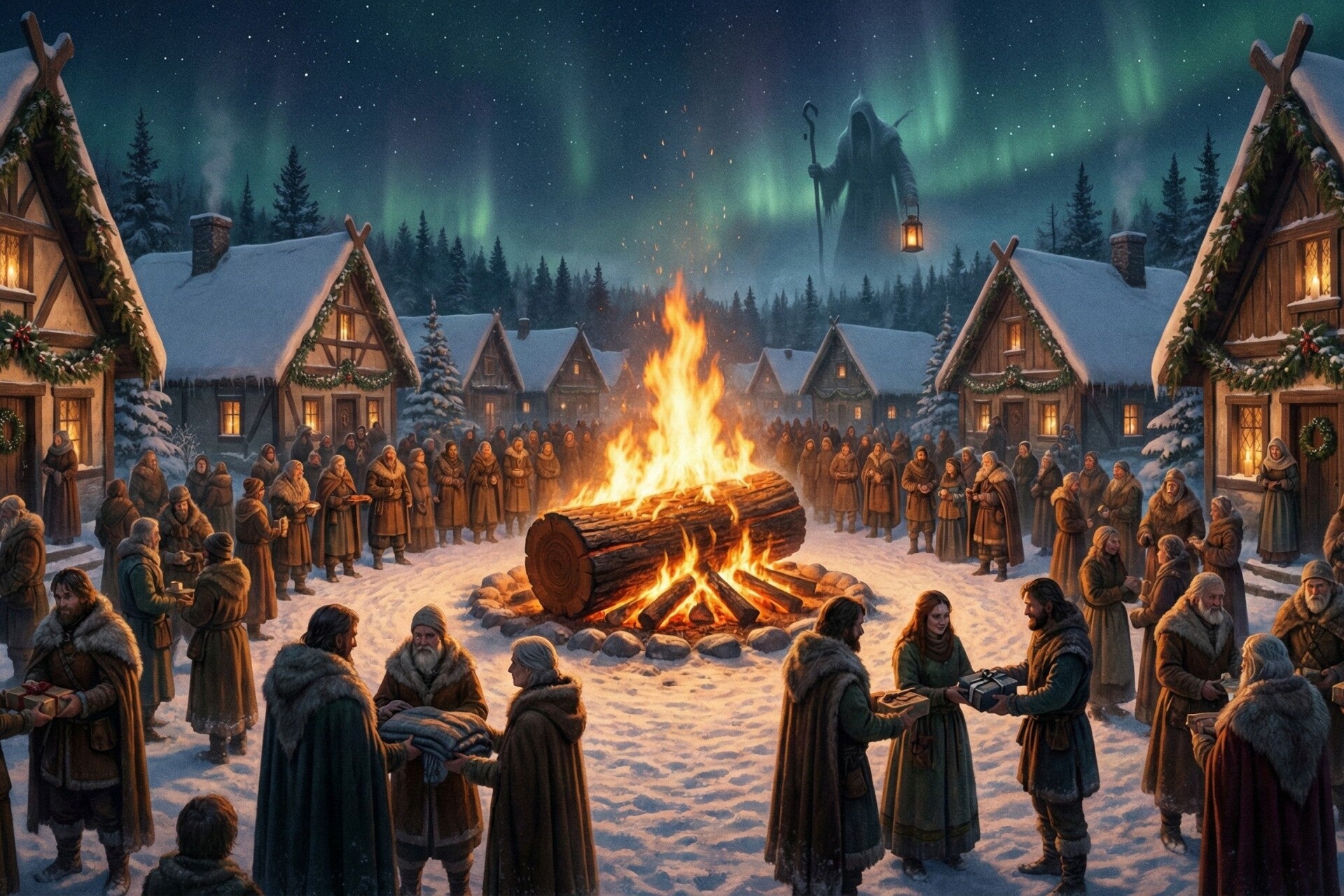
The Festival of the Eternal Ember
(Commonly known as: Ember-Eve, The Frost-Binding, or The Longest Watch)
* Location: Realm-wide (Observed by all factions and races).
* Timing: The 21st Day of the Obsidian Moon (The Winter Solstice).
* Scope: Universal Survival Ritual.
The Festival of the Eternal Ember is the most significant, universally observed holiday in Stellarealm. Occurring on the Winter Solstice—the single longest night of the year—it marks the astronomical turning point where the World-Song falls to its quietest whisper.
In a realm defined by the struggle between civilization and the untamed wild, this holiday is not merely a celebration; it is a ritualistic act of collective survival. It is the night the mortal races "sing the sun back to life," binding themselves together against the encroaching Primal forces of ice and entropy. While theologically distinct between the Primal-worshipping tribes and the Celestial-worshipping cities, the core ethos remains the same: The Covenant of Kinship. The belief is that on this night, no spark should burn alone.
The Mythic Figure: The Frost-Walker
Stellarealm does not have a jolly gift-bringer; it has The Frost-Walker (also known as Old Winter, The Keeper of the Quiet, or The Lantern-Bearer).
* Lore: He is an ancient, neutral Arch-Primal Spirit, depicted as a towering giant shrouded in a cloak of weaving snow and grey wool. He carries a staff of Weirwood and a rusted iron lantern containing a Captured Star (a fragment of the Age of Falling Stars). He walks the realm on the Long Night not to judge "good" or "evil," but to judge the "Warmth of the Spirit."
* The Tradition: Children and elders alike place a "Spirit-Candle" in the window and leave out a plate of Salt-Bread and Dark Ale.
* The Blessing: If the household has been generous, maintaining the Covenant of Kinship, the Frost-Walker leaves a Frost-Rune on the doorframe (invisible to the eye, but felt as a gentle heat). This ensures the hearth fires will burn hot and efficient for the rest of the winter.
* The Pinch: If the household has been greedy or cruel, he pinches the wick of their Spirit-Candle. For the rest of the season, their fires will smoke, their wood will rot, and the chill will seep through the walls.
The Three Phases of the Frost-Binding
The celebration spans three distinct days, a triad representing the Past, the Present, and the Future.
Day 1: The Dusk-Wait (The Cleansing)
* The Ghost-Place: As the sun sets on the eve of the Equinox, families set an extra place at their dinner tables. This seat is reserved for the Ancestors and the Frost-Walker. It is a solemn time of remembrance where stories of those lost to the cold are told, ensuring their names remain in the "Warmth of Memory."
* The Iron-Log: Every household, from the humblest shack in the Heartland to the grandest estate in Nocturne, brings in a massive log. Traditionally Ironwood or Oak, it must be dragged, not carried, across the threshold.
* The Carving: Before it is lit, each family member takes a knife and carves a rune or symbol into the bark representing a Regret or Hardship from the past year. By burning the log, they release these burdens to the smoke.
* The Green-Binding: Homes are decorated with boughs of Ever-Needle Pine, Silver-Holly, and Ghost-Berries. In Stellarealm lore, these plants possess a "Static Primal Charge" that acts as a natural ward against Wraiths and malevolent winter spirits that roam freely during the solstice.
Day 2: Ember-Eve (The Covenant)
* The Lighting: At the exact moment of true midnight, when the darkness is deepest, the Iron-Log is lit. It is tradition to light it with a flame preserved from the previous year’s fire (the "Seed Flame"). If this was lost, a Hedge-Mage or Priest must bless new flint.
* The Covenant Exchange: This is the height of the celebration. Gifts are exchanged, known as "Covenant Gifts." These are rarely frivolous toys; they are functional items symbolizing a promise of mutual survival.
* Examples: Fur-lined cloaks, forged daggers, preserved jars of Sun-Honey, or Mana-infused amulets.
* The Vow: The giving phrase is ritualistic: "I give you this so you may survive the cold, and I will stand with you until the spring."
* The Feast of Fat and Honey: A massive meal is consumed to fuel the body against the cold. The menu focuses on heavy, preserving foods: roasted boar, root vegetables glazed in maple, dense nut-breads, and spiced Mulled Wine laced with restorative alchemy.
Day 3: The Dawn-Greeting (The Renewal)
* The Sun-Song (The Lumen-Vox): As the sun finally crests the horizon after the longest night, entire communities gather outside. They sing a choral hymn, a low, thrumming melody meant to mimic the vibration of the sun, "calling" it back to strength.
* The Ash-Blessing: The cold ashes of the Iron-Log are collected in jars. These "Sacred Ashes" are sprinkled on the threshold of the home, the barn, and the boundaries of the land to ward off sickness and bad luck for the coming year.
Ready to explore Stellarealm?
Discover the races, lore, and stories of our unique fantasy world.